What SF Crime Data Actually Reveals About Urban Safety: Spring 2026 Trends in San Francisco
For a while, San Francisco became national political theater.
Crime clips. Retail theft videos. Surface-level tenderloin walkthroughs from commentators who spent a weekend in the city and came home talking like they had embedded with a war correspondent unit. Bill O’Reilly recently did exactly this, filming a whirlwind Tenderloin tour and presenting it as a definitive statement about San Francisco as a whole. Not ok, IMO.
Some of that attention came from real deterioration. The 2020-2022 post-COVID period was rough. Downtown emptied out. Office workers disappeared. Open drug use became more visible. Public order got shakier. Recovery here was slower and more visible than places like New York because San Francisco was so dependent on office density, convention traffic, tech infrastructure, tourism, and downtown foot traffic all feeding each other.
If you were regularly walking Market Street, Civic Center, SOMA, or parts of the Tenderloin during those years, you felt it directly.
But the broader public narrative about San Francisco mostly froze there while the city itself kept improving underneath it. And the Spring 2026 crime numbers paint a more complicated picture than the version of San Francisco that still dominates some right-leaning media coverage and online conversations.
Positive trends over the last two years are not subtle. Check out the data:
Citywide March-May Crime Trends
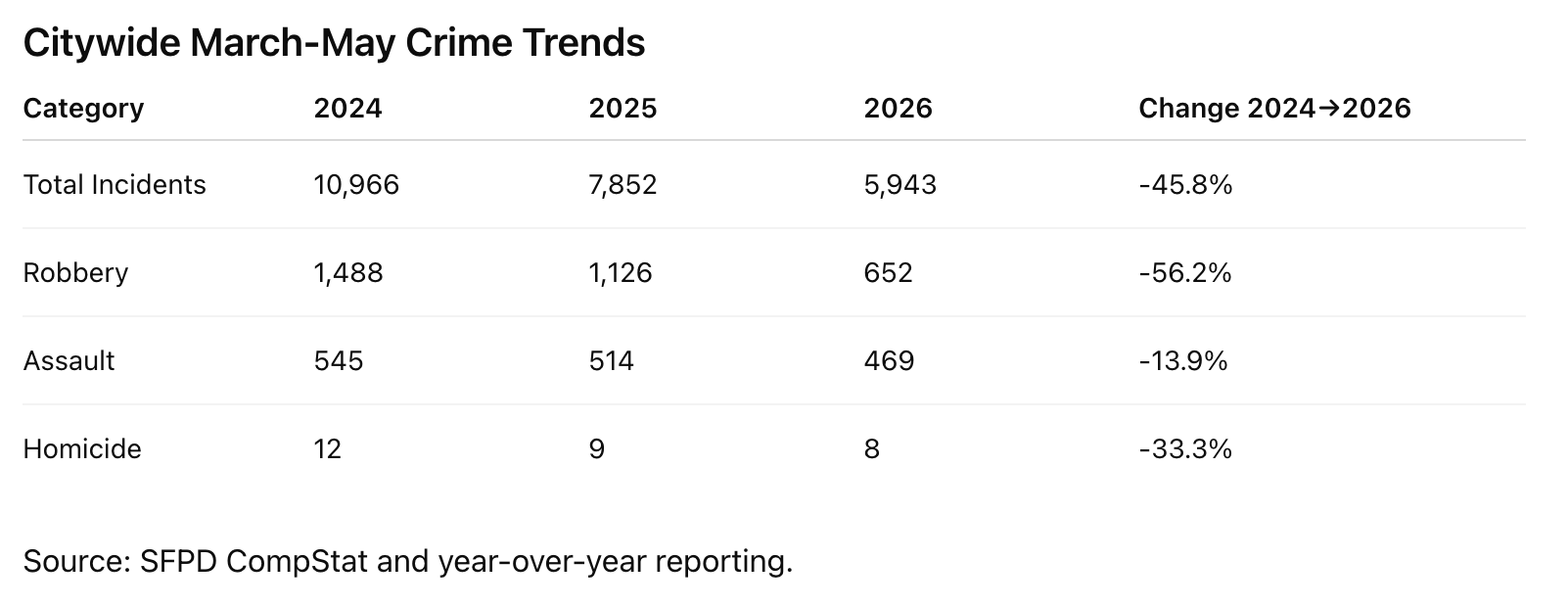
Those robbery numbers are especially significant. Reported robberies during this March-May window are down more than 56% from Spring 2024 to Spring 2026.
The monthly SFPD CompStat reporting tells a similar story. Compared to March 2024:
reported violent crime dropped 33% in March 2025
robbery dropped 21%
assault dropped 24%
April looked similar:
violent crime down 28%
robbery down 22%
assault down 19%
That is a meaningful shift over a relatively short period of time.
San Francisco’s improvement is also not happening in isolation. Major crime has been falling in several large U.S. cities after the post-2020 spike. New York reported major crime declines in 2025, with murders and shootings below pre-pandemic levels, though felony assaults remained elevated compared with 2019. Los Angeles reported a 19% homicide decline in 2025, with homicides reaching their lowest level since 1966.
San Francisco’s numbers still stand out in a few ways. SFPD reported that 2025 homicides fell to 28, the city’s lowest count since 1954, while shootings dropped 16%, violent crime fell 18%, property crime fell 27%, robberies dropped 24%, and robbery with a firearm dropped 45%.
That context matters. San Francisco was not the only city hit hard by the post-COVID crime and disorder cycle. It was one of the cities where the collapse narrative got the loudest, partly because downtown emptiness, tech remote work, tourism disruption, open drug use, and visible street disorder all stacked on top of each other in a small, dense, globally recognizable city.
You can feel some of the recovery operationally too. Streets are cleaner than they were a few years ago. There are more city workers visible in public spaces and more police presence on BART platforms and major transit corridors. Weekend foot traffic has rebounded. Restaurants are fuller. Giants games, neighborhood festivals, races, farmers markets, and outdoor events all feel busy again. Hayes Valley feels noticeably more active at night than it did during the hollowed-out post-COVID years.
At the same time, talking about “San Francisco crime” as though the entire city behaves uniformly is basically useless.
The patterns are concentrated. They always have been.
The Mission, Civic Center, the Tenderloin, and parts of SOMA continue to account for a disproportionate amount of robbery, assault, weapons offenses, visible instability, nightlife friction, and transit-related crime. None of that is particularly new. These neighborhoods have carried concentrated poverty, addiction, vice economies, and street violence for decades, in some cases for more than a century.
They are also four neighborhoods out of more than twenty major San Francisco neighborhood groupings. They are not the totality of the San Francisco experience, even if they dominate the online conversation.
The Mission remained one of the city’s highest-volume robbery and assault districts this spring.
Mission District Crime Trends
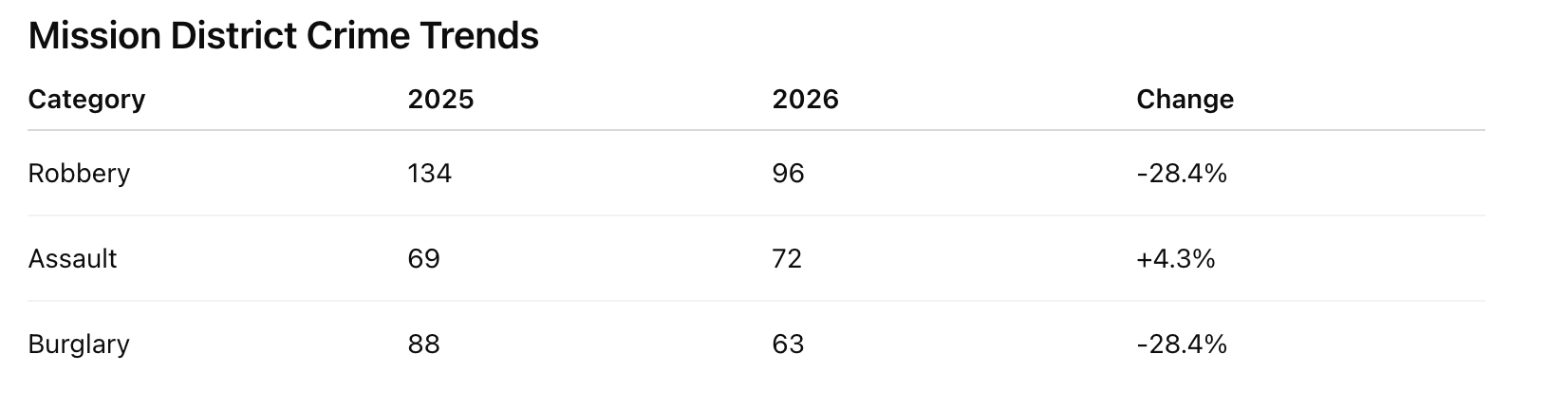
That table tells a pretty familiar big-city story. Robbery and burglary moved down sharply while assault stayed mostly flat. Depending on where somebody lives, whether they ride transit daily, whether they work nightlife hours, or whether they regularly move through dense corridors late at night, they may experience those realities very differently.
The Tenderloin numbers stand out more sharply.
Tenderloin District Crime Trends
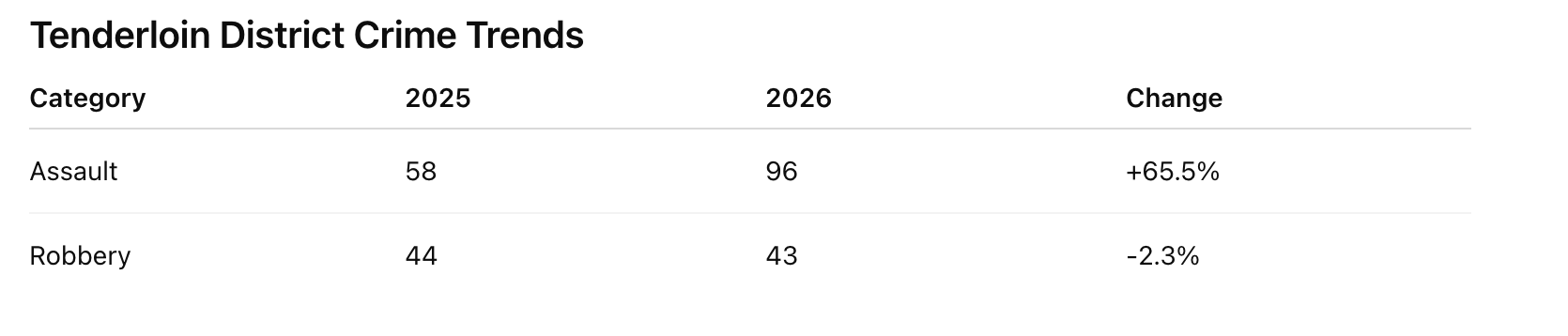
That assault increase matters because these categories involve serious bodily injury or weapons, not just verbal conflict or low-level disturbances.
And honestly, this is where broad political narratives about cities start becoming less useful than simply paying attention to geography, infrastructure, density, timing, and movement patterns.
Forge is located in Hayes Valley, which sits in a particularly interesting part of the city geographically. Hayes borders Civic Center, the Western Addition, NOPA, Alamo Square, Van Ness, and sits relatively close to both Market Street and the Mission. Some of those adjacent areas are calmer residential zones. Others carry much higher levels of transit traffic, nightlife activity, addiction, instability, or concentrated street crime.
Hayes itself has generally felt pretty good lately. Cleaner. Busier. More active at night. Restaurants packed. Patricia’s Green full again. And the local data supports some of that.
Hayes Valley Crime Trends
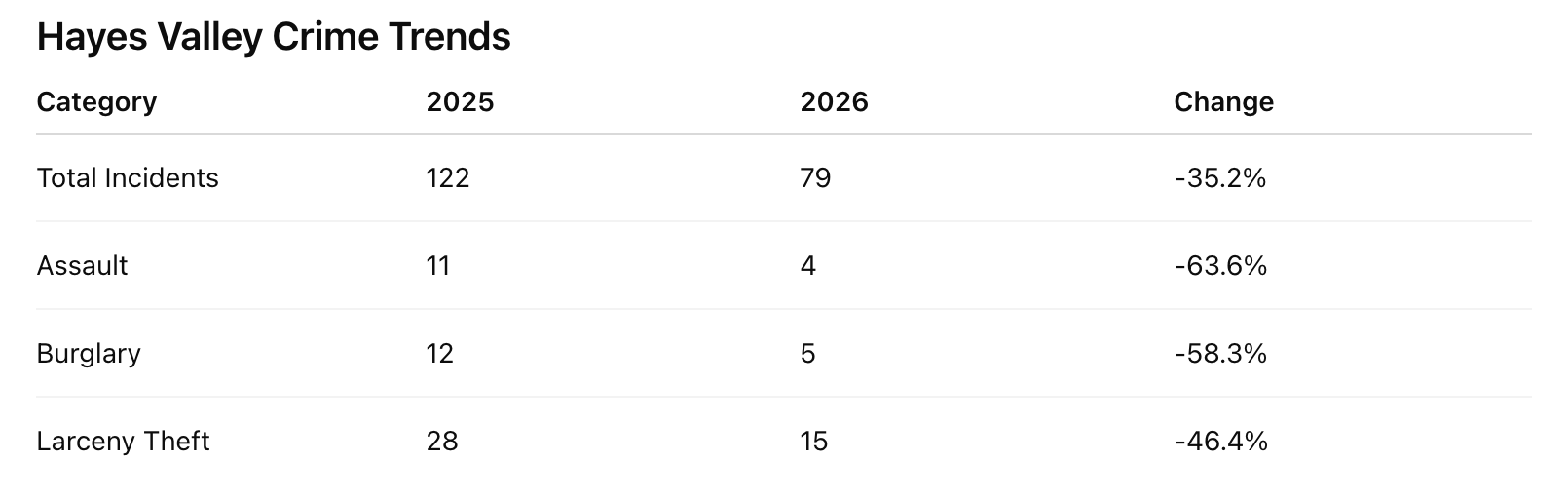
Small-number categories like robbery fluctuate more dramatically and are harder to interpret cleanly neighborhood-to-neighborhood. But the broader Hayes trendline currently looks considerably more stable than the adjacent Civic Center and downtown transition corridors.
That distinction matters.
Hayes Valley does not function like an isolated neighborhood bubble. It functions more like connective tissue between very different parts of the city. Residential blocks. Transit corridors. Nightlife. Downtown office flow. Civic Center. Van Ness. Different levels of density, visibility, intoxication, tourism, and social friction all interacting with each other constantly.
A LOT of urban vulnerability lives inside those transitions.
Leaving bars late at night. Walking from BART into quieter blocks. Waiting for rideshares while staring at your phone. Parking garages. Loading equipment into cars after events. People mentally clocking out because they already feel “basically home.”
The weapons data reinforces the same pattern. SFPD assault reporting breaks incidents into categories involving:
Firearms
Knives and cutting instruments
Hands, fists, feet
Other dangerous weapons
The good news is that San Francisco still remains relatively low in firearm homicide compared to many major American cities. Homicides stayed in single digits during this reporting period.
But weapons offenses and knife-related assaults remain heavily concentrated in the same downtown, nightlife, and transit-heavy environments already carrying elevated assault numbers. The incident maps make this pretty obvious.
Again, concentrated. Not random.And honestly, that is probably the biggest disconnect in how people talk about San Francisco right now. The city does not feel like “nothing is wrong.” It also does not feel like the urban collapse fantasy some people online still want it to be. It feels like a major city recovering from a rough period. Slowly in some places. Faster in others.
Yes, it’s still uneven. Yes , it’s very expensive and income disparities are stark. Yes, we are still carrying visible social problems. Still requiring awareness, solutions, and action. But materially different than the version of San Francisco that became national shorthand for urban collapse a few years ago.
I’m not an urban planner, but IMO cities run - at least partly - on psychology. Confidence, trust, foot traffic, social cohesion, public optimism. Once people emotionally decide a city is dead, the narrative inertia sticks around long after the underlying conditions start changing. But the infrastructure underneath can still improve anyway. That increasingly feels like what is happening in San Francisco right now.
Still a city, though. Still requires awareness. And honestly, that is part of why self-defense matters in the first place. Not because San Francisco is uniquely dangerous. Big cities have always required attention management, environmental awareness, and some understanding of how human behavior changes under stress, density, intoxication, distraction, isolation, and transit friction.
The goal for San Francisco Krav Maga students is not paranoia. The goal is our education, awareness and personal competence.
Data Sources
SFPD Crime Dashboard: https://www.sanfranciscopolice.org/stay-safe/crime-data/crime-dashboard
SFPD CompStat Reports: https://www.sanfranciscopolice.org/stay-safe/crime-data/crime-reports
NYC Crime Trends Reference: https://www.vitalcitynyc.org/crime-in-new-york-city-trends-statistics/
LAPD Crime Data Release: https://lacity.gov/news/los-angeles-police-departments-2025-crime-data-report-released
